
If You Catch Bugs In Your House & Release Them Outside You Probably Have 10 Rare Emotional Gifts
 Tatyana Soares | Shutterstock
Most people are genuinely afraid of bugs and can't fathom doing anything but squishing them when their paths cross.
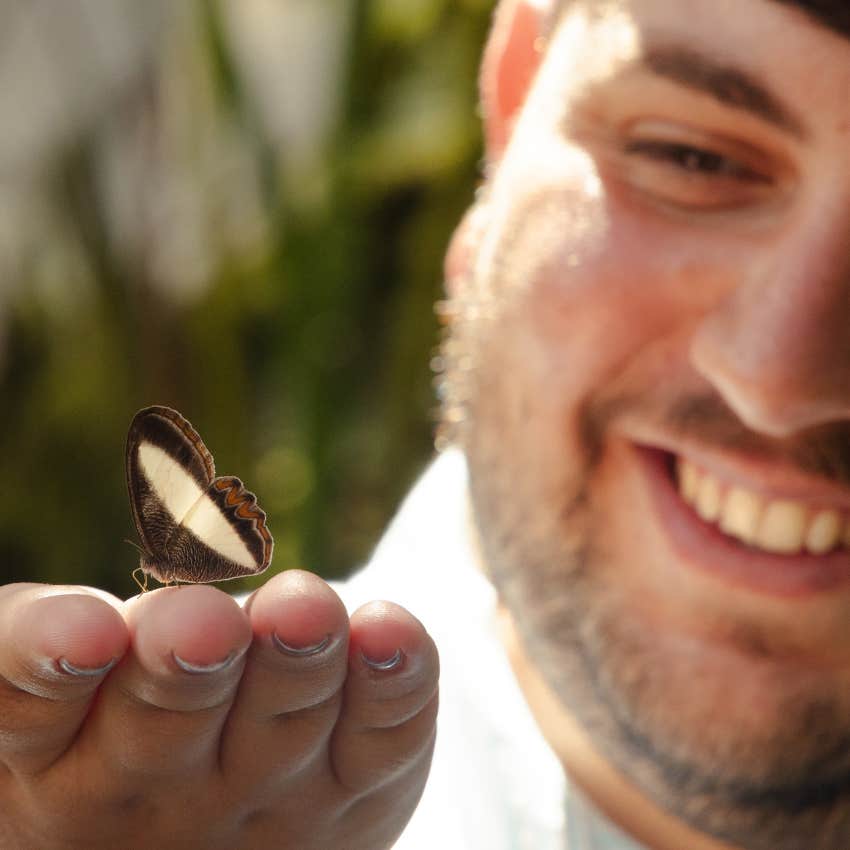
However, research from Proceedings of the National Academy of Sciences suggests insect brains often have similar functions to the human brain, including our ability for awareness. So, while it might be inconvenient, uncomfortable, and sometimes incredibly scary, if you catch bugs inside your house and release them outside you probably have certain rare emotional gifts, including a sense of morality and genuine empathy for other living creatures.
1. You have empathy for things others overlook
 Halfpoint | Shutterstock
While empathy is often nuanced and manifests in different ways depending on the person, it's a superpower for people navigating our increasingly narcissistic society. They put themselves in another person's shoes, care about morality, and lead with compassion in ways others overlook to make space for entitlement.
"In general, empathy is a powerful predictor of things we consider to be positive behaviors that benefit society, individuals, and relationships," social psychology professor Karina Schumann explained. However, for people who catch and release bugs, their empathy also exists for other living things, even if they can't necessarily place themselves in the experience of an insect.
2. You're emotionally regulated
When you're afraid of something, you deal with your emotions inside. Rarely do complex emotions like embarrassment or shame shift your behaviors with the things and people around you. It's a superpower that often takes a lot of practice and internal stability to learn, but for bugs, which most people are afraid of, it saves their lives.
You don't believe that your fear should justify killing a bug. It's as simple as that, on paper. In your head, you're coping with and managing any complex emotions that are coming up, but at the end of the day, it's a moral, intentional decision you're able to choose with a clear mind.
3. You act with intention
Instead of immediately reacting with their fear in mind or being hasty without thinking, intentional people act thoughtfully. Whether it's having a conversation or managing a spider hanging out in the corner of a room, they don't act on impulse. They act on intentionality. While it might take more time and effort, experts believe that living an intentional life truly boosts both happiness and well-being.
"Individuals who have a clear sense of purpose not only live longer but also experience better sleep, more happiness, and less feelings of loneliness. We can think of our intention as a 'micro purpose,' which acts as an immediate, attainable goal that enriches our days with meaning. It's these little goals that make a big difference in our lives, bringing with them a steady flow of joy," psychologist Harry Cohen revealed.
4. You don't seek control
Many people who seek control over others and their lives operate from a place of constant anxiety and place their nervous systems in "fight or flight" mode. They don't like uncertainty, but instead of regulating their emotions in our lives that are inherently changeable and unpredictable, they try to control people and their circumstances for stability.
From chronic anxiety to depression and poor support or relationships, trying to control everything externally is typically a sign of inner turbulence that leads to all kinds of misguided symptoms. However, the same people who treat insects in their home humanely operate from a place of internal security through emotional regulation, whether they have "control" over everything or not.
All that matters is that they're internally grounded and in control of their own feelings and emotions, even if a spider unexpectedly greets them somewhere in their home.
5. You have a gentle urge to protect
 brenda photolpx | Shutterstock
A PNAS study argues that our willingness to protect things and people depends on how "costly" we perceive the outcome to be. So, if we're faced with a toxic person or draining situation, usually we figure out how willing we are to support or exert effort based on the severity of our future hurt or pain.
That's part of the reason why people who have a gentle urge to protect the people and things around them release bugs they find at home, instead of immediately destroying them. They know they're not going to get hurt by taking care of the bug and protecting its life, even if it means they have to lean into some inconvenience and fear to do so.
6. You're patient
When dealing with minor inconveniences, small misunderstandings, and annoying things that would throw the average person for a loop, a patient person leads with grace. Especially considering that minor inconveniences tend to cause more stress and inner turmoil for the average person than the big stuff, this gentle patience is a superpower.
When catching bugs, even when it's inconvenient and a little bit scary, it's this patience that allows people to simply release them outside. They're careful and intentional, but also have the patience to take the extra time to treat them with humanity and respect that others miss.
7. You're not competitive
While we often think of competition happening between two people, the "you versus us" mentality that fuels this mindset is also present with other things and living creatures. When someone has a sense of superiority over something, even if it's a bug, it can lead to a lot of aggression and cruelty that's entirely unnecessary.
However, if you catch bugs and treat them with kindness by releasing them outside, you don't have that innate sense of being "better" than someone or something else. You lead with compassion because you don't have anything to prove, externally or internally.
8. You're mindful of the impact of decisions
Whether it's a sense of humanity toward animals and living things or an appreciation for thoughtful decision-making, people who are mindful of the impact of their decisions are the same ones who treat bugs and insects with kindness.
You're respectful of the right to co-exist with other things and beings, because, despite what our modern society tells us to believe, we're not "better" than another living creature simply because we're humans.
9. You're responsible with power and influence
 byswat | Shutterstock
Whether it's in the workplace as a leader or taking care of bugs in your home as a human, people who take responsibility for their power with compassion are more thoughtful than their arrogant counterparts. They don't lead with a sense of entitlement and carelessness because they can do whatever they want, but instead try to lead with empathy to make good choices for everyone and everything around them.
While some high-power people lose touch with reality, their humanity, and empathy, these individuals are always tapped into a kind of humility that allows them to make these intentional, moral decisions.
10. You tolerate discomfort
Considering embracing and working through discomfort is often the key to growth as a person, according to a study from Psychological Science, having the emotional regulation skills to lean in is a true superpower. Although it's rare in our society today that's largely driven by entitlement and convenience, this rare emotional gift allows people to grow without control or external praise.
While taking care of bugs and insects isn't necessarily a life-changing means of growth, simply practicing the emotional regulation it takes to lean into humanity and discomfort protects these people from falling victim to inhumane norms and expectations.
Zayda Slabbekoorn is a senior editorial strategist with a bachelor's degree in social relations & policy and gender studies who focuses on psychology, relationships, self-help, and human interest stories.

