
People Who've Switched From Airbnb To Hotels Usually Say 6 Things Changed Their Minds
 Margo Evardson | Canva
Recently, my friend had to book an Airbnb for a photoshoot. The shoot didn’t pan out, so I ended up coming over, and we hung out. It was a beautiful place in the most surprising of cities.
I nicknamed it the “Secret Mansion,” though it was in an apartment building. It looked like a Hollywood mansion, but was located in a building with an exterior that looked rough around the edges. But, I digress.
Lately, I noticed something a bit unusual about my shoot trends as well as the trends I’ve seen in travel. Not too long ago, Airbnb was the go-to for travel, but now, almost everyone agrees that it’s better to go back to booking hotel rooms. What gives?
Airbnb was once the “little guy” in hospitality. When Airbnb first came in, it was a way for people to live out their dream of having a cute little family-run hotel. It was meant to give people a quick way to make money by using their extra rooms or extra properties.
At first, Airbnb was a casual affair. It was a way to get a room for multiple people at a cheaper rate than a hotel would charge. You often got to meet the owners; there was a community vibe to it, and, of course, you were helping people who might not have had an opportunity to “house hack” otherwise. Then, things changed.
Then, Airbnb blew up, becoming a major cultural phenomenon and serious issue in real estate. Airbnb might have started as a simple, casual thing, but it didn’t stay casual for long. Some Airbnb companies started to blow up, to the point that the homeowners started to buy up other houses in the vicinity.
When people would book a trip somewhere, they often would balk at the idea of paying for “expensive hotels,” which meant that demand quickly skyrocketed. This turned into a major problem in larger tourist cities. Airbnb buyers started to edge out actual homeowners and renters in cities like Las Vegas and Myrtle Beach — an increase in Airbnbs has been linked to rent increases in their respective areas.
It’s gotten so bad that some cities, including New York City, now have laws capping Airbnb at a set number. This goes back to what I was saying: Airbnb was a major part of the 2010s, but wow, it’s quickly fading out of the public eye. To say that Airbnb is in free-fall is an understatement.
Airbnbs are no longer frequently booked or even preferred among renters. In some areas, the trend has already turned around, with investors unloading their Airbnbs to wholesalers as well as actual homebuyers.
It’s not just the bad reputation for what the Airbnb world does to the rental market, either. Several major issues have caused this once-popular service to go the way of the dodo. Let’s talk about the economics of it.
People who've switched from Airbnb to hotels usually say these things changed their minds:
1. It's become more corporate and less community-oriented
It used to be that people who supported Airbnb did so because they wanted to help out the “little guy.” However, the majority of Airbnbs are now owned by people who own more than five houses.
That’s not a community. That’s a corporation — and a vulture one, at that. It’s harming the locals in the area by jacking up rent prices. That means that, by design, it lacks that feeling of homey, humble community that once made Airbnb so attractive.
2. Scammers have run rampant
This entire article was started because I saw this post on Reddit.
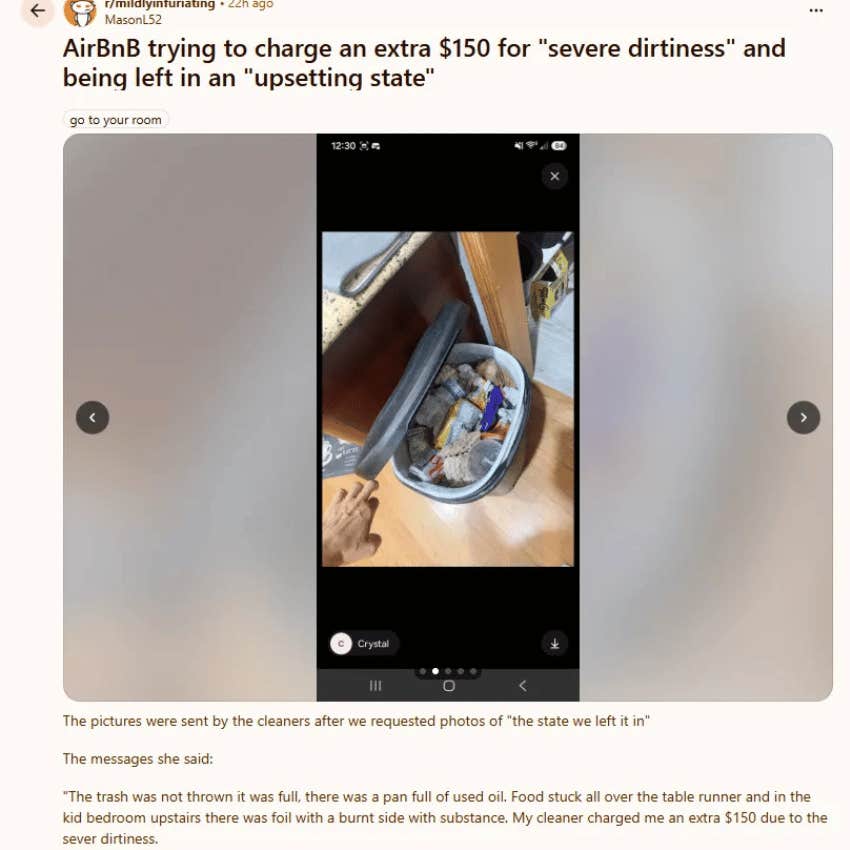 Photo from Author
This photo was outed as being AI-made in the comments, which means that the person who was hosting this venue was actively trying to extort their guests with fake images and accusations.
The person here is trying to hit them up with another $150 charge on top of the actual price. Aggravating as that is, it’s not the only issue that can come with Airbnb. LifeLock posted a list of several common scams that make each booking a gamble, including:
- Fake venues. They also mentioned that hosts might do a last-minute switch by saying the venue “has an issue,” but that you can stay at a much less nice place.
- Damage accusations. This scammer is far from the first one to try this. This is usually made worse by demanding damage fees that don’t match what they accused you of.
- Inaccurate descriptions. They mention a whirlpool, but there is no whirlpool. What can ya do?
Airbnb is dealing with a lot of these right now, but that’s also not even the only issue travelers are dealing with.
3. Extremely strict rules have tamped down on what you can do
Airbnb owners are allowed to make rules about what can and cannot happen in their venues. This seems reasonable at first glance, as they should be able to exercise that right. However, a lot of hosts take it too far. Along with the standard rules like not smoking, some hosts will include crazy rules like:
- Imposing a very strict time limit on check-in and check-out. This can make sense if you’re on a strict schedule, but is 10 minutes really too late to check in?
- What you can and cannot cook in the house. I mean, you’re not Walter White. You’re not cooking meth. Banning curry or fried foods is insane.
- No spraying perfume. In at least one Airbnb, you were literally banned from wearing perfume while at the venue.
- Limiting shower time. What? Do you want people to smell like body odor then?!
- Quiet hours that include snoring. How can you actually control whether or not you snore? Apparently, this has happened in at least one Airbnb.
- No children allowed on the premises. So far for that “family-friendly” vibe the company was going for…
A lot of these places become so restrictive that they no longer actually make sense to rent.
4. The fees often negate any savings that you’d get from booking an Airbnb over a hotel
Hotels are not cheap, but they often end up being cheaper than some comparable Airbnbs. For example, I’m a huge fan of retro love hotels. They cost about $100 a night, and you can do whatever you want within reason.
If you get a fee at a hotel, it’s generally because you messed up. It takes a lot of damage or mess to get a fee charged by a hotelier. Parking fees? Well, they tend to match the local parking lot rates or are cheaper.
Airbnbs, on the other hand, are allowed to charge fees at their discretion. What often happens is that hosts end up playing very fast and loose with their fees. The biggest problem with Airbnb is that you don’t always know the full price until after you check out. And this can turn a vacation or a necessary business trip into a financially destabilizing issue.
Imagine thinking that you were getting a place for $250, only for the final tab to be double, triple, or quadruple that amount. That’s the shocking reality many people have faced when working with Airbnbs.
5. Hosts have become skittish about who stays there
I’ll actually side with the hosts on this one: hosts have a right to get nervous when they’re inviting total strangers into their home. Most hosts have a decent amount of back-and-forth when it comes to learning about the guests and researching what they’re like.
Airbnb doesn’t always give you the full story through reviews. Bad reviews can happen for a variety of different reasons, which is why the platform will often remove bad reviews flagged as “unfair” or “fraudulent.”
The funny thing is, a lot of those bad “unfair” reviews are actually trying to warn others of scammers or excess fees. The same can be said of decent Airbnb hosts. So, it’s a bit of a Catch-22 on both sides.
6. In recent years, there’s also been a growing call for tipping hosts
Uh, why? Because you paid to exist near them? Right now, Airbnb is officially “stalling,” but is it really stalling?I don’t think it’s stalling. Stalling suggests that the growth is flatlining. If it were stalling, investors wouldn’t be offloading their properties.
According to the official stats: “In 2025, revenue grew to $12.2 billion, up 10% year-on-year. Gross Booking Value crossed $91 billion. More than 533 million nights and experiences were booked on the platform. Free cash flow was strong at $4.6 billion, with margins close to 38%. On most operating metrics, Airbnb continues to look like a durable, profitable platform. And yet, the stock has not reflected that strength. Over the past year, Airbnb shares have delivered negative returns, even as several large technology names have moved higher.” — Financial Express
At first glance, that sounds good. Revenue is up, at least at face value. However, the returns are not as high, and many people are dipping out of the Airbnb market.
That doesn’t happen for a reason. More often than not, it’s because the people who run the Airbnbs are not getting a good return. They might be doing more than what they expected to for less. And knowing that, it’s kind of a rough deal.
Personally, I prefer hotels. Hotels don’t judge. Hotels don’t get in your face, and they don’t have the same level of scamminess that people might run into from an Airbnb. They have protections and guidelines they need to follow.
Ossiana Tepfenhart is a writer whose work has been featured in Yahoo, BRIDES, Your Daily Dish, Newtheory Magazine, and others.

