
Smart Little Girls With Undiagnosed ADHD Likely Grew Into Women Who Now Do 10 Specific Things
 Pressmaster / Shutterstock
For decades, ADHD was often associated with boys who were impulsive or unable to sit still in class. Many girls, especially those who were bright and well-behaved, didn't fit that stereotype. Because they were so eager to please, they learned to mask their struggles or work twice as hard to keep up, leaving their symptoms unnoticed well into adulthood.
As awareness has grown, many women have started looking back on their childhoods through a different lens. Behaviors they once dismissed as laziness or being too much now make more sense in light of what researchers know about how ADHD can present in girls. While these experiences don't necessarily mean someone has ADHD, and only a qualified healthcare professional can make that determination, many women who were diagnosed later in life recognize the same patterns that quietly followed them from childhood into adulthood.
Women who were smart little girls with undiagnosed ADHD do these specific things now
1. Feel panicked by innocent feedback
 DimaBerlin | Shutterstock.com
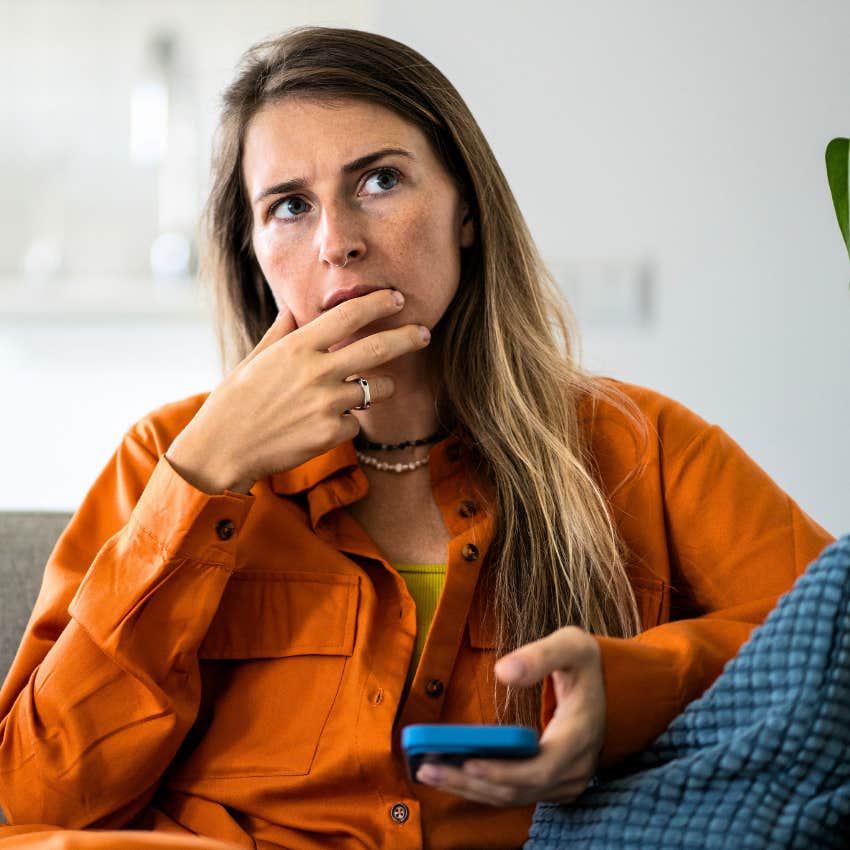
If you grew up with undiagnosed ADHD while also being a gifted child, the struggle with perfectionism is real. Not only were you expected to know and handle everything, but undiagnosed ADHD prompted perfectionist behaviors as a way to mask struggles with focus and disorganization.
As adults, that desire to be perfect only gets stronger without a clear diagnosis and support. That’s why harmless messages like “Do you have a second to chat?” or calls starting with “We need to talk” can immediately spark chaos in their nervous systems.
They’re afraid of feedback and having their struggles put on display, even when they’re not bad things, because they’ve spent their entire lives trying to cover them up, subconsciously or not.
2. Struggle with self-love and celebration
Even though they can rattle off their high school GPA and every award they’ve gotten since college, women who grew up with undiagnosed ADHD may struggle as adults to give themselves the credit they deserve. That’s because when they achieve something they’re striving toward, they don’t feel pride, but rather, relief.
They’ve spent their lives pushing back against real struggles from ADHD, without any kind of clarity or acknowledgment of what those struggles stemmed from. They had to work twice as hard in many cases and prove themselves, creating a work ethic that didn’t allow space for celebration.
3. Dull themselves in conversations
For young girls who do fit somewhat hyperactive forms of ADHD, even when they don’t align with traditionally male symptoms, it’s not uncommon for them to deal with labels like overly emotional or annoying.
They were the little girls who always had something to say and a million things to share with the group. They were happy, excited, curious girls, whose lights were slowly dimmed by the stereotypes and judgment of the world around them. Now, as adult women, they subconsciously diminish themselves with every passing interaction, work meeting, and first impression.
They’ve been taught that being talkative is bad, especially for women who can’t be assertive or dominating in conversations without pushing back on traditional norms.
4. Over-prepare for everything
So many women who grew up gifted, both with ADHD and without, feel the need to over-prepare for everything. They are constantly in the game of proving themselves and coping with the feeling that they’re going to be somehow found out, even in the workplace.
Their imposter syndrome overworks them, because they’re doing double the work preparing for things than a person or co-worker who can confidently show up as themselves. They rehearse conversations. They script their meeting notes. They go above and beyond, for the sake of perfectionism, but also for comfort and relief.
5. Cling to their hyper-independence
 THICHA SATAPITANON | Shutterstock.com
As kids, they worried about proving themselves to others and seeking external praise. As adults, they cling to their hyper-independence and sometimes suppress their own needs to cope with that inner fear of failure, rejection, and abandonment.
They never want to be too much for someone, because they’ve spent too many years of their lives being called that.
6. Always consider the worst-case scenario
The back-up plans, and back-up back-up plans, are constantly in the back of these women’s minds. At all times. They can’t help it. When they’re not preparing to do something perfectly, they’re worrying about what could go wrong and trying to prepare.
Even when it cultivates negativity and pessimism in their daily routines, it has become a coping mechanism. For their entire childhoods, they’ve been judged and criticized for symptoms of ADHD. As adults, they internalize it all, making their symptoms worse, but also burdening themselves with all kinds of mental health risks and stress.
7. Showing up way too early
Executive functioning issues are common for women with ADHD, and when you spend most of your life without a diagnosis, symptoms like showing up late can become a self-perceived weakness. They think they’re a bad person because they can never show up on time, because everyone yells at them for it.
That’s usually where the cycle starts. They’re shamed and blamed, and in adulthood, swing to the opposite end of the spectrum. Now, they show up way too early, still suffering from time blindness, but afraid to be late at the expense of their social image or emotional well-being.
8. They over-apologize
Called chatty and talkative as kids, usually in a critical or judgmental way, it’s no surprise that many women with undiagnosed ADHD over-apologize for those behaviors now. They’ve been taught that they’re inherently bad or weaknesses of their character, even when they’re simply a sign of their personality or symptoms of ADHD.
Because men are often supported with their ADHD, and their symptoms are easily accepted in our society, women are left to manage and cope on their own.
9. Deal with imposter syndrome
 MAYA LAB | Shutterstock.com
Especially for women who are pressured to be quieter and more agreeable than men, it’s no surprise that they’re used to dulling their accomplishments.
For women with ADHD, that feeling of being an imposter is even more heightened. They don’t feel like they deserve to be in specific rooms. They work a million times harder to prove that they are. They constantly feel like an outsider.
10. Keep a list of a million ideas
Whether it’s hobbies they want to try or interests they want to come back to, women with undiagnosed ADHD have a million lists floating around at all times. Their minds are racing with a million ideas, but with the pressure to be perfect at all of them, usually, they’re left to collect dust.
They really struggle to try new things or adopt hobbies they’re bad at, which tends to create rigidity in their lives that becomes exhausting over time.
Zayda Slabbekoorn is a senior editorial strategist with a bachelor’s degree in social relations & policy and gender studies who focuses on psychology, relationships, self-help, and human interest stories.

