
If A Parent Had These 11 Troubling Traits, Their Adult Children Probably Resent Them Now
 Tint Media | Shutterstock
Pretty much everyone dreams of a multi-generational family where everyone feels loved and accepted. But according to Pew Research Center, an estimated 18% of young adults don't have anything near that. Instead, too many adult children resent their parents, especially if they had a few specific troubling traits.
For parents whose adult kids don't talk to them often enough, it can be hard to figure out where the resentment comes from. After all, they feel they did their best and want their children to forgive them. Often, the only think keeping that from happening is the parent not understanding how the things they did hurt their kids.
Here are 11 traits of parents whose adult kids often resent them once they grow up
1. They violate boundaries
 Mortion Films | Shutterstock
Setting boundaries and drawing lines will always be uncomfortable, but healthy parents respect their kid's boundaries and will do their best to respect them, even at the expense of their own discomfort. As long as a child is safe and not harming others, they should be respected as much as possible.
But parents whose adult children resent them are often chronic boundary violators, and it is one of the most troubling traits a parent can have. As psychotherapist Sean Grover L.C.S.W., explains, kids whose parents don't respect boundaries often feel tremendous guilt when they try to enforce them as adults. Often, they don't even know what it looks like to set, enforce and respect them with others.
2. They're gaslighters
 NTshutterth | Shutterstock
There's nothing more heart-wrenching than a parent who tries to gaslight their kids into believing that they're the ones at fault. After all, in order to gaslight them, the parent has to convince their child they're "crazy" or that they cannot trust themselves, and few things are further from the mission of a good parent than that.
Good parents, the ones whose kids love and respect them even when they're grown adults, teach their kids how to trust their gut. They are a safe space to land, where the truth will be told in ways that help create stability.
Those who parent by lying, a term that which can happen in varying degrees of lying to influence kids' behavior, do just the opposite, creating an instability that makes kids feel unsafe.
3. They're bad at apologizing
 Krakenimages | Shutterstock
Parents who refuse to take accountability for their actions create a situation where a child feels unseen, even when their parents obviously made a bad choice. Often, these parents are afraid that if they say they're sorry, their kid will take advantage of them or see them as weak.
In reality, saying you're sorry to kids is a healthy practice that not only models accountability for kids, it also helps build trust. Researchers who studied the effects of parental apologies on adolescents determined that "more victim-centered and less defensive apologies were related to higher needs satisfaction and lower needs frustration" which are measures of healthy development.
Without parental apologies, adult children often grow resentful, and can lead them to cut ties with their parent. After all, why would adult kids continue to try when a parent can't even admit to their wrongdoings?
4. They use shame to attempt to control others
 fizkes | Shutterstock
There's nothing more demeaning than a parent who humiliates their children as a form of punishment. According to child development expert Marlena Romero, LCSW, writing for Colorado Children's Hospital, "Public shaming is destructive to adolescent identity," whether it happens online or in real life.
She notes that embarrassing or negative comments made by parents can turn into a self-fulfilling prophecy. As a result, children believe whatever negative qualities their parents called out when shaming them.
Whether parents like it or not, negative comments thrown in the middle of a grocery store (or anywhere else) can absolutely damage their kid's self-esteem. As a result, adult kids often resent them as adults, feeling dehumanized and belittled in the presence of their parents.
5. They're control freaks
 fizkes | Shutterstock
Whether the parent compulsively tried to control what their kids wore or who they hung out with, resentment is likely to build. Often, these parents believe they're protecting their children. Other times, the parents are too steeped in narcissism to give up control.
Allowing kids to experience appropriate levels of independence is actually beneficial, even though it might scare or stress a controlling parent out. A study published in 2021 found that encouraging children's independence leads to higher motivation, confidence, and self-esteem.
This is because children know that whatever problems life throws their way they'll be able to handle them without needing to depend on others. As a result, these kids feel equipped and prepared to enter the real world, which in turn, strengthens the bond they have with their parents.
Meanwhile, when a parent has the troubling trait of being controlling, their adult children grow resentful and crave a life where they can fuilly be themselves.
6. They’re closed-minded
 KucherAV | Shutterstock
Most people know that open communication is the building block to healthy relationships, and parent-child relationships are no exception. Not only does open communication prevent misunderstandings, but it can also deepen bonds as trust between parent and child begins to flourish.
Furthermore, it provides children with an opportunity to open up about their challenges and mistakes in order to receive support and advice. According to Joanna Schroeder, co-author of 16 Conversations to Help Tweens and Teens Grow into Confident, Caring Young Men, without a safe place to talk with a trusted adult, kids have to rely on their own judgement.
"It's important to give kids more independence to make choices and develop their own good judgment. But," she advises, "kids need a lot of guidance in order to get to the place where they can be trusted to do what's right, especially in confusing or high-pressure situations."
That's why parents need to do their best to be open-minded. "If kids think their parents will judge them," she continued, :freeze them out or punish them when they open up, they'll simply stop doing it. Then they're left to make these decisions themselves or seek advice from other adults, not all of whom will be trustworthy."
Not only is this a problem when kids are young, but the mistrust will likely cause resentment well into adulthood.
7. They seem impossible to please
 AstroStar | Shutterstock
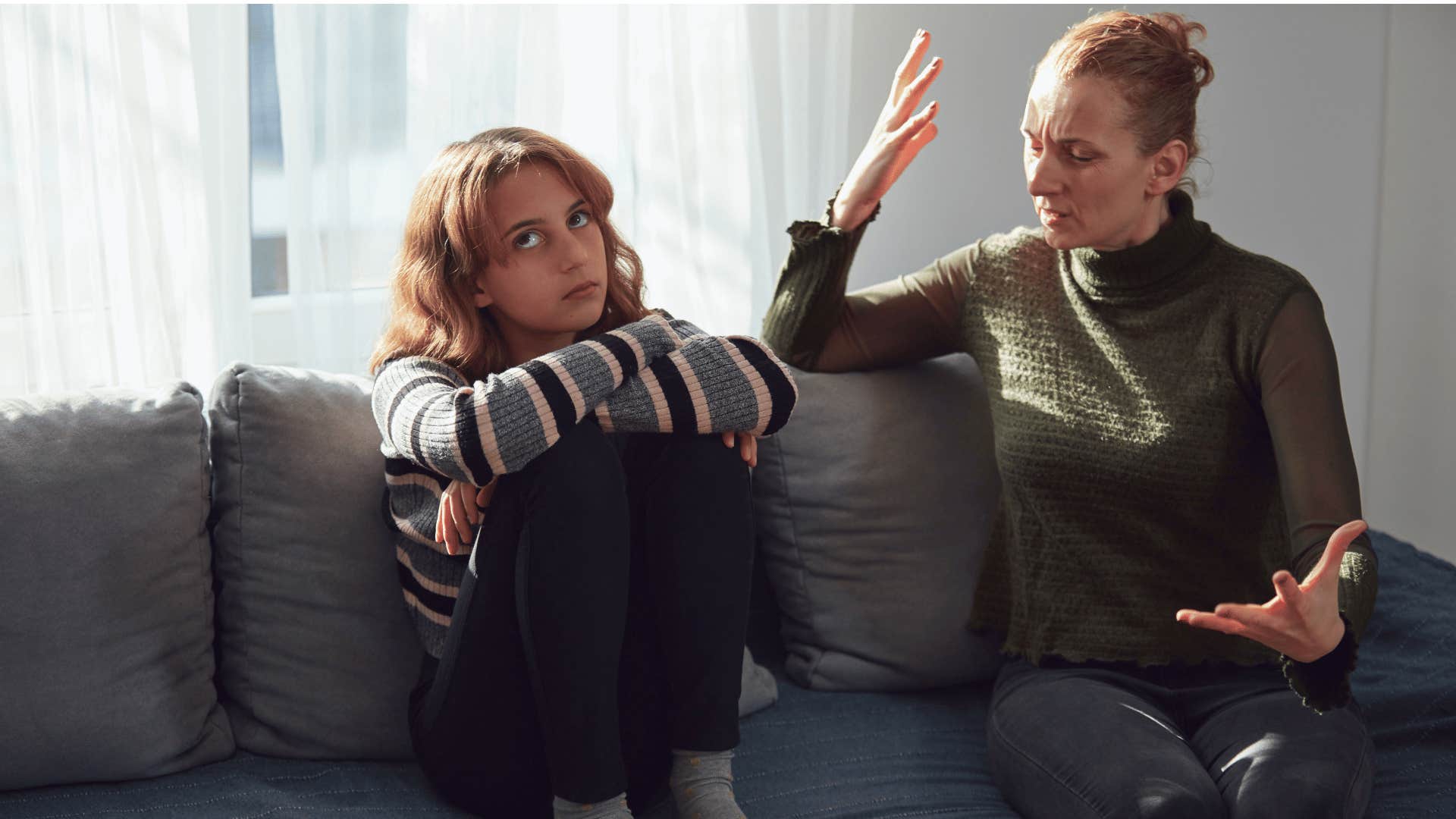
Many overly critical parents have some form of deep-rooted insecurity, and, as a result, continuously demand perfection from their kids. Feeling deeply embarrassed by their own life failures in life, parents will load on expectation after expectation, with little regard for their kid's mental well-being.
High and even unrealistic parental expectations isn’t uncommon; in fact, the effects of it are well known. A report published by the American Psychological Association analyzed data from over 20,000 Americans and Canadians. Researchers found that young people’s perception of their parent's expectations and criticism has increased over the past 32 years.
The researchers note that perfectionism often leads to depression, anxiety, and other mental health problems. It's no surprise, then, that kids and teens are experiencing high levels of stress!
If parents have expectations that feel impossible to achieve, it's stressful. If that achievement is linked to love, affection, approval and/or attention, it's a recipe for major resentment when that child becomes an adult.
8. They use fear to get what they want
 Wasana Kunpol | Shutterstock
Too many parents use fear and threats to enforce compliance with their kids. Not only does this make their kids mistrust them, when they become adults, their children resent them and often cut off communication.
Often traumatized by their own upbringing, these parents often pass on the trauma to their kids, likely not knowing better or having the skills to interrupt the pattern. Their adult children, however, have more access to information than any generation before, and have likely learned that this method of parenting was cruel and unneccessary. They also likely learn that they aren't obligated to maintain a relationship with parents who were so willing to use fear to control them.
This is even worse when compounded by physical punishment. Sadly, this type of behavior isn’t uncommon; in fact, the World Health Organization estimated that 60% of children regularly suffer from physical punishment by a parent or caregiver. This often backfires on parents, as children who are struck often have worse outcomes than those whose parents utilized non-violent parenting skills.
9. They use money to control people
 Dobo Kristian | Shutterstock
Financial coercion is a serious form of manipulation, and if a parent had this troubling trait, it's not surprising their adult children resent them.
Of course, everyone gets to decide what to spend their money on, but parents who use it to control their kids aren't being smart with finances, they're playing on their minor children's fears while having total control over their lives. After all, kids need their parents' money for all sorts of things, from food to clothes and even school tuition.
While their research was focused on intimate partner financial abuse, according to BMC Public Health cites studies that found economic abuse is linked to a range of negative outcomes. The outcomes, including decreased parent-child interactions.
That said, toxic parents may not realize how their financially controlling ways impact their kids for the worse. These parents may assume that it’s normal to use finances to keep children in line or punish them if they misbehave. However, this type of behavior had devastating consequences.
In turn, adult kids who didn’t get their needs met growing up are less likely to offer that same support back to their parents, leading to a closed-off relationship on all fronts.
10. They treat love as conditional
 fizkes | Shutterstock
Every kid needs unconditional love from their parents. According to a 2013 study from UCLA, unconditional love from a parent helps children feel less anxious and more happy.
Sadly, too many parents in the past have treated love like a tool to control or even punish their kids. If they weren't doing what their parents wanted, love with be withdrawn. A parent might stop talking to the child, stop saying "I love you" or stop being affectionate as a punishment of sorts.
Not only does this push a child away, it often creates resentment that lasts well into adulthood. According to the study cited above, it can also take a serious toll on a child's (and even an adult child's) mental health and well-being.
11. They minimize their kids success
 Perfect Wave | Shuttetstock
Many older people, including parents with adult children, struggle to congratulate their children for their success. Feeling jealous and insecure, these parents will either choose to ignore their adult kids' success or sabotage their success completely.
Sadly, jealousy from parents isn’t uncommon. As psychotherapist Annie Wright, LMFT, explains, feeling jealous can be normal and natural, especially when comparing it to their own upbringing. Of course, this doesn’t excuse parents who engage in toxic behaviors for their own benefit.
After all, healthy parents who feel jealous will always find healthier outlets to release negative emotions rather than pilling them onto their children. Often, they need some professional support to come to terms with what they didn't have in their own lives, and to reconcile their feelings with their values, so they can behave better toward their children, regardless of their age.
Marielisa Reyes is a writer with a bachelor's degree in psychology who covers self-help topics such as relationships, career, family, and astrology.

